
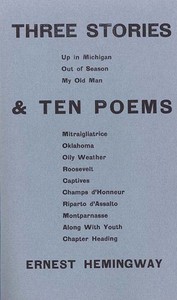
Three Stories & Ten Poems by Ernest Hemingway
Let's be clear: this isn't a novel. It's a literary time capsule. Published in 1923 when Hemingway was just a young expat in Paris, this was his first commercial book. The three stories—'Up in Michigan,' 'Out of Season,' and 'My Old Man'—are short, focused glimpses into moments of disappointment, awkwardness, and loss. A clumsy romantic encounter by a dock. A fishing trip that goes all wrong. A boy figuring out his jockey father might not be a hero. The ten poems are even more direct, little bursts of imagery and feeling that often read like the bare notes for his future stories.
The Story
There's no single story to follow. Instead, you get snapshots. 'Up in Michigan' shows a brief, uncomfortable encounter between a man and a woman, hinting at much more than it says. 'Out of Season' follows a guide and a tourist on a pointless fishing trip, their silence speaking volumes. 'My Old Man' gives us a boy's loving but clear-eyed view of his father's flawed life. The poems jump from war to love to Parisian streets, all delivered in that famous, stripped-down style. The plot is in the style itself—watching a new way of writing being built, sentence by sentence.
Why You Should Read It
You read this to witness the moment the engine turns over. The famous 'Iceberg Theory'—where most of the meaning is hidden beneath the surface—is already working here. Hemingway isn't telling you how people feel; he's showing you what they do and say, and letting you figure out the rest. It's incredibly powerful. You have to lean in and participate as a reader. There's a thrilling roughness to it, too. It's not always smooth, but it's always alive. You can feel him trying things, seeing what he can get away with by leaving things out. It makes you appreciate the polished mastery of his later work even more, because you see where it came from.
Final Verdict
This is a must for any Hemingway fan who wants to understand his roots. It's also perfect for writers, or anyone interested in how artistic style develops. If you're new to Hemingway, this is a fascinating, bite-sized place to start—you can read the whole thing in an hour, but you'll think about it for much longer. It's not his easiest or most satisfying book, but it might be his most important. It's the blueprint.
This publication is available for unrestricted use. Preserving history for future generations.
Dorothy Sanchez
2 months agoHonestly, it provides a comprehensive overview perfect for everyone. Exceeded all my expectations.
Ethan Martin
3 months agoRead this on my tablet, looks great.
Andrew Lopez
10 months agoAfter finishing this book, it manages to explain difficult concepts in plain English. Exceeded all my expectations.
Thomas Miller
9 months agoThanks for the recommendation.






Susan Anderson
9 months agoRight from the opening paragraph, the argument presented in the middle section is particularly compelling. This adds significant depth to my understanding of the field.