
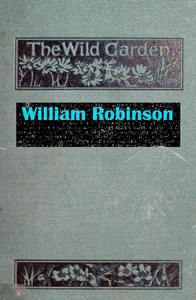
The Wild Garden by W. Robinson
First published in 1870, William Robinson's The Wild Garden doesn't have a plot in the traditional sense. There's no hero's journey, but there is a mission. Robinson was a gardener and journalist who looked at the high-maintenance, artificially colorful gardens of the Victorian era and said, "There has to be a better way."
The Story
The book is his manifesto. He introduces the concept of the "wild garden," which is less about letting everything go to seed and more about thoughtful, naturalistic planting. He championed using hardy perennial plants, shrubs, and bulbs that could thrive with minimal fuss. He wanted gardens that had depth, seasonal change, and a sense of place—gardens that felt alive rather than arranged. He spends pages describing how to naturalize plants like daffodils in grass, how to let climbers ramble over trees, and how to create beautiful effects with plants that actually belong in your climate. The "story" is his argument, building from one chapter to the next, showing how this approach is more beautiful, economical, and in tune with nature than the formal bedding schemes of his day.
Why You Should Read It
Reading this book feels like having a conversation with a brilliant, slightly cranky friend who is fed up with nonsense. Robinson's passion is contagious. Even if you've never put a plant in the ground, you can feel his love for the simple beauty of a bluebell wood or a meadow full of flowers. His ideas are the bedrock of modern gardening movements like "cottage gardening" and the current trend for native plant gardens and ecological landscaping. It's humbling to realize that the relaxed, lush garden style we often aspire to today was a radical act of defiance back then. The book connects you to the very moment gardening broke free from being just a display of wealth and control.
Final Verdict
This is a must-read for any gardener who feels guilty about a few weeds. It's perfect for the plant lover who dreams of a yard full of life, not just decoration. History buffs will geek out over this snapshot of a cultural shift. Most of all, it's for anyone who needs permission to relax, to trust nature a little more, and to find beauty in the wilder corners. Just be warned: after reading it, you might start eyeing your own lawn as a potential wildflower meadow.
This text is dedicated to the public domain. Distribute this work to help spread literacy.
Ava Johnson
1 year agoAfter hearing about this author multiple times, the storytelling feels authentic and emotionally grounded. A valuable addition to my collection.
Anthony Anderson
10 months agoAs someone who reads a lot, it challenges the reader's perspective in an intellectual way. I couldn't put it down.
Jackson Brown
1 year agoRead this on my tablet, looks great.
Jennifer Nguyen
1 year agoThis is one of those stories where the pacing is just right, keeping you engaged. A true masterpiece.






Kimberly Martin
3 months agoThe author provides a very nuanced critique of current methodologies.