
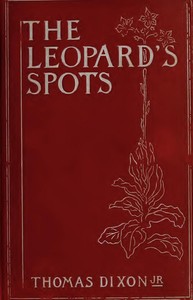
The Leopard's Spots: A Romance of the White Man's Burden—1865-1900 by Dixon
Let's talk about a book that's more of a historical artifact than a simple story. 'The Leopard's Spots' is a challenging window into a mindset that many today would find abhorrent, but one that was powerfully persuasive to its original audience.
The Story
The novel follows Charles Gaston, a young man from North Carolina, from the end of the Civil War into the late 1800s. We see him grow up in a defeated South, become a lawyer, and enter politics. The central plot revolves around his love for a woman and his political ambitions, but the real engine of the story is its argument about race. The book portrays the Reconstruction era as a catastrophic failure, painting Black political participation as a disaster and the Ku Klux Klan as heroic restorers of order. The title comes from a biblical reference—the idea that a leopard cannot change its spots—used here to argue that racial characteristics and hierarchies are fixed and unchangeable.
Why You Should Read It
I won't lie, reading this was tough. The characters are flat vessels for ideology, and the racism is not just a background element—it's the thesis statement. So why bother? Because this book wasn't just a story; it was propaganda that worked. It helped codify the 'Lost Cause' myth and justified segregation and disenfranchisement for generations. Reading it firsthand, you feel the emotional pull of its narrative, how it frames Southern resentment as noble and paints a terrifying, fabricated picture of 'Black rule.' It's a masterclass in how fiction can be weaponized to shape reality. Understanding this rhetoric is crucial to understanding a huge swath of American history and the persistence of certain ideas.
Final Verdict
This is not a book for casual entertainment. It's for readers and students of history, sociology, or political science who want to engage directly with source material. It's for anyone seeking to understand the literary and cultural foundations of white supremacy in America. You don't read it to agree with it—you read it to comprehend the depth and nature of the opposition to racial equality. Pair it with critical essays or works from Black authors of the same period for necessary context. It's a difficult, important, and profoundly unsettling piece of our national story.
This book is widely considered to be in the public domain. Feel free to use it for personal or commercial purposes.
Steven Lopez
1 year agoHonestly, it provides a comprehensive overview perfect for everyone. Exceeded all my expectations.






Patricia Martin
4 months agoI was skeptical at first, but the flow of the text seems very fluid. A true masterpiece.