
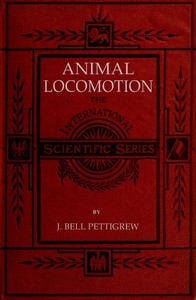
Animal Locomotion; or, walking, swimming, and flying by James Bell Pettigrew
Published in 1873, Animal Locomotion is James Bell Pettigrew's life's work presented in one volume. He wasn't content to just describe how animals move. Pettigrew was driven by a bigger idea: that all movement—walking, swimming, and flying—follows the same fundamental rules. The book is his attempt to prove it.
The Story
There isn't a plot in the traditional sense. Instead, Pettigrew takes us on a systematic tour of the animal kingdom. He starts with the basics of muscular movement and skeletal levers. Then, he gets into the good stuff. He breaks down the walk of a horse, the slither of a snake, the powerful stroke of a whale's tail, and the intricate flight of insects and birds. For each, he uses detailed diagrams and his own observations to show how their motion is really a variation on a theme. The central 'character' here is his theory, often called the 'figure-of-eight' theory for flight. He argues that a bird's wing doesn't just flap up and down; it twists and moves in a specific, screw-like pattern that is the key to efficient flight. The whole book builds as evidence for this unifying principle.
Why You Should Read It
You should read this for the sense of wonder. It's a snapshot of scientific thinking in the Victorian era, right after Darwin. Pettigrew writes with absolute conviction in his theory, and his enthusiasm is contagious. The hundreds of illustrations are worth the price of admission alone—they're beautiful, precise, and help you see animal bodies as elegant machines. It's humbling to realize how much he figured out without modern technology. More than that, it makes you look at the everyday world differently. You'll never watch a pigeon land or a squirrel jump the same way again. You start to see the engineering in nature.
Final Verdict
This book is perfect for curious minds who love natural history, early science, or beautiful old books. It's a great fit for readers of authors like David Attenborough or Steve Brusatte who enjoy biology told with a narrative flair, though Pettigrew's style is more technical. Artists and animators studying movement will find it a goldmine. Be warned: it's a serious 19th-century scientific work, so it requires a bit of focus. But if you're willing to engage with it, Animal Locomotion is a rewarding journey into the mind of a man who saw a hidden symphony in every step, swim, and flight.
The copyright for this book has expired, making it public property. You can copy, modify, and distribute it freely.








Thomas Williams
9 months agoInitially, I was looking for a specific answer, but the nuanced approach to the central theme was better than I expected. A solid investment for anyone's personal development.